For readers evaluating stable video diffusion tools, this review offers a focused comparison of Higgsfield and Kyncept, examining whether multiple generated clips provide meaningful visual variation rather than merely different files.
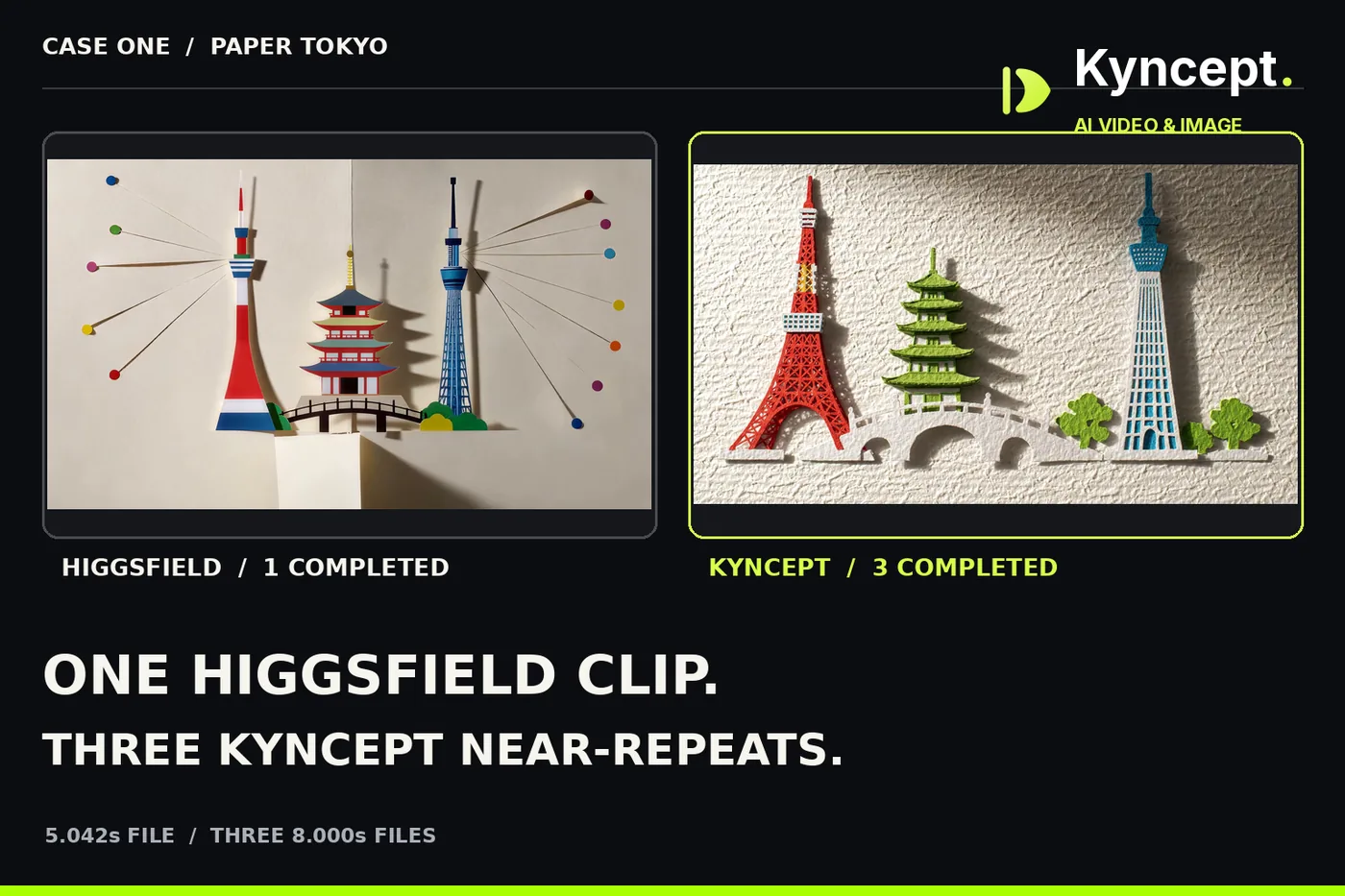
A text-only Tokyo paper-cut prompt produced a real, downloadable Higgsfield video. The surprise in this case was not a failed competitor: it was that three successful Kyncept videos looked remarkably alike.
My verdict in 60 seconds
Higgsfield successfully delivered one 5.042-second Wan 2.5 Fast MP4 after a single submission. Kyncept delivered three 8.000-second MP4s from the same video prompt, but their pairwise full-frame SSIM scores clustered around 0.989. If the job is one illustrated Tokyo beat, both products returned something tangible. If the job is three visually varied alternatives, these three Kyncept results are a warning against assuming that three generations equal three distinct ideas.
- Delivery — Higgsfield: one submitted, one completed; Kyncept: three submitted, three completed.
- Duration — Higgsfield: 5.042 seconds from a 5-second UI selection; Kyncept: 8.000 seconds on each output.
- Files — Higgsfield: 1904×1104 at 24 fps; Kyncept: 1280×720 at 24 fps.
- Observed debit — nine Higgsfield credits versus ten Kyncept credits per run; those are different products' units, not interchangeable money.
- Variation — the three Kyncept MP4s are not identical files, but the visible storyboard is strikingly similar across them.
The comparison report includes the prompt, timeline evidence, frame samplers and all four unmodified MP4s. This is one small case, not a reliability benchmark.
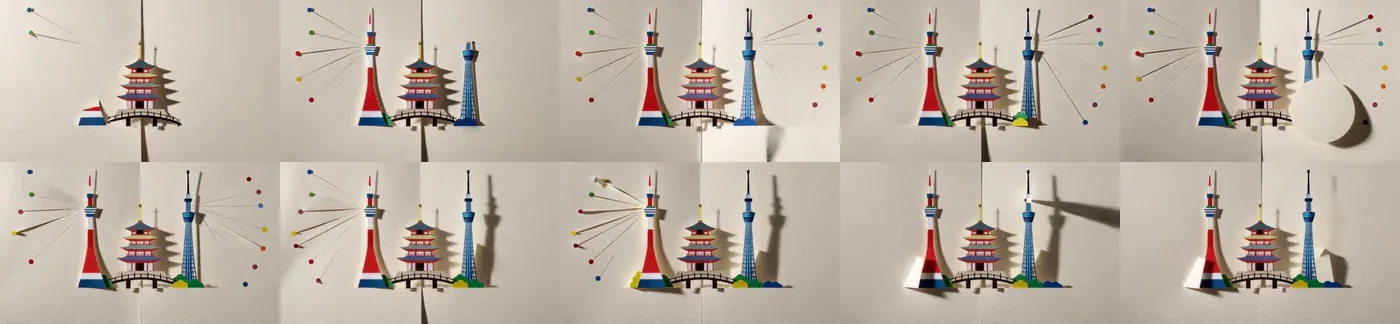
Frames sampled at half-second intervals from the successful Higgsfield file; the strip is evidence of a moving output, not a substitute for watching its full 5.042 seconds.
The limit of this comparison
This is an independent hands-on comparison of two third-party tools, run once on each side. Both products were tested on my own accounts — a free tier and a paid plan — with no vendor-provided access. It links to the downloadable outputs and the visible task records so a reader can dispute any judgment about composition or usefulness. Kyncept and Higgsfield are the two products in this trial. None of these four video outcomes should be extrapolated into a universal platform success rate.
The original social posts inspired the theme, not the wording of either submitted prompt. Both interfaces received the same adapted video text, including its instruction to make an eight-second 16:9 paper-cut stop-motion scene. Both interfaces were set to 16:9. A crucial difference remains: the Higgsfield duration menu was set to 5 seconds, whereas the Kyncept files ran for 8 seconds. Identical prompt text does not turn different duration controls into an identical job specification.
What the prompt actually requested
The test text asked colored dots to snap into radial lines, assemble Tokyo Tower on the left, Skytree on the right and a five-tier pagoda behind a bridge. It also asked for layered cardstock shadows, an ending where the shapes collapse into a red disk, paper-flick sounds, sparse percussion and no voice. These are checkable instructions, not proof that either platform met every one. In particular, this case did not include listening or speech recognition, so the audio requirements remain unverified.
The visual samplers are more useful than a single hero frame. The first Kyncept sampler contains colored dots and a radial arrangement, then a Tokyo landmark tableau, and finally a red disk. The Higgsfield strip shows the paper landmark scene and colored dots with lines across its shorter run. The full originals are linked in the case report; a grid does not establish exact timing or that every requested transition happened in order.

Four representative frames of Kyncept run 1. The red ending disk is visible in the sampler; the sound instructions have not been assessed by ear.
The Higgsfield task succeeded, regardless of a nearby old failure card
The submitted Higgsfield task used Wan 2.5 Fast with the UI displaying 5s, 720p and 16:9. The video balance went from 10 to 1, consistent with a nine-credit deduction in Higgsfield's own unit. A later read-only check against the matching Tokyo task showed completed, and the corresponding 9,526,540-byte MP4 was downloaded and inspected. There was one submission for this Tokyo video, not a series of failed retries.
A nearby “Failed / Credits refunded” badge belonged to another task, not this Tokyo submission. Task correspondence, the completed card and the playable file establish this outcome; an adjacent badge in a crowded history screen does not.
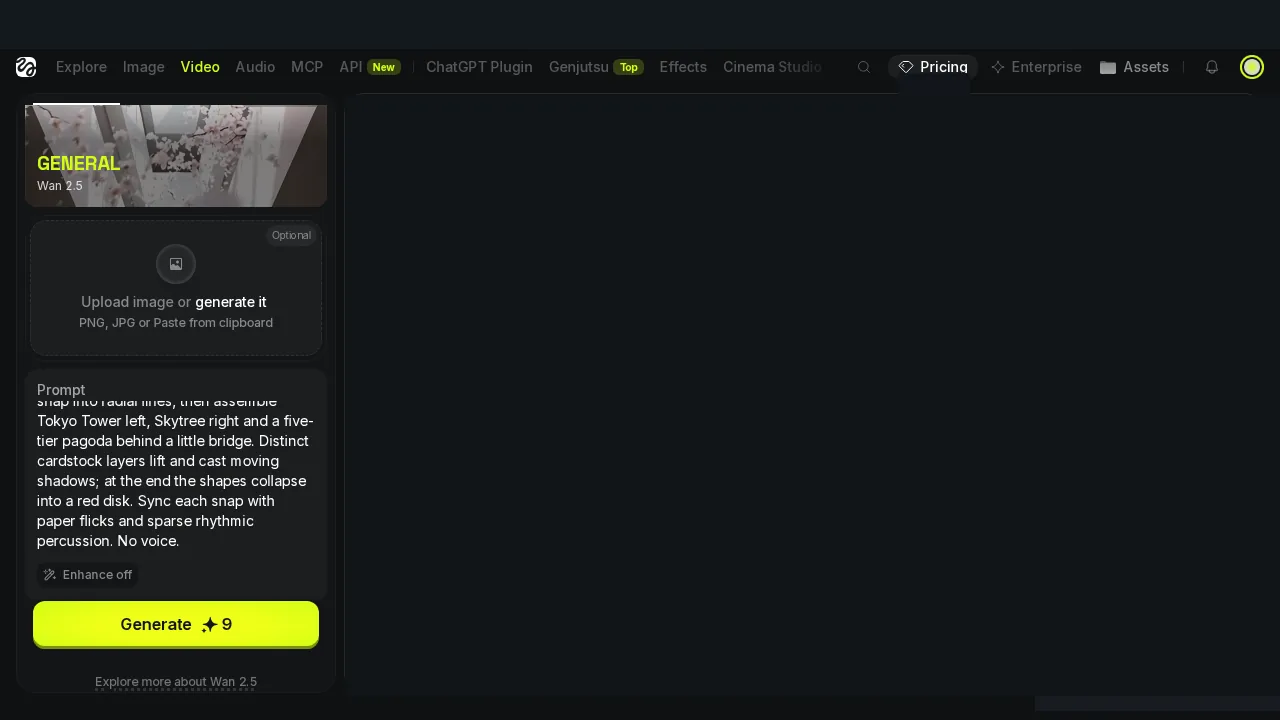
The actual Tokyo submission settings show the 5-second menu choice. The text of the prompt still asks for eight seconds.
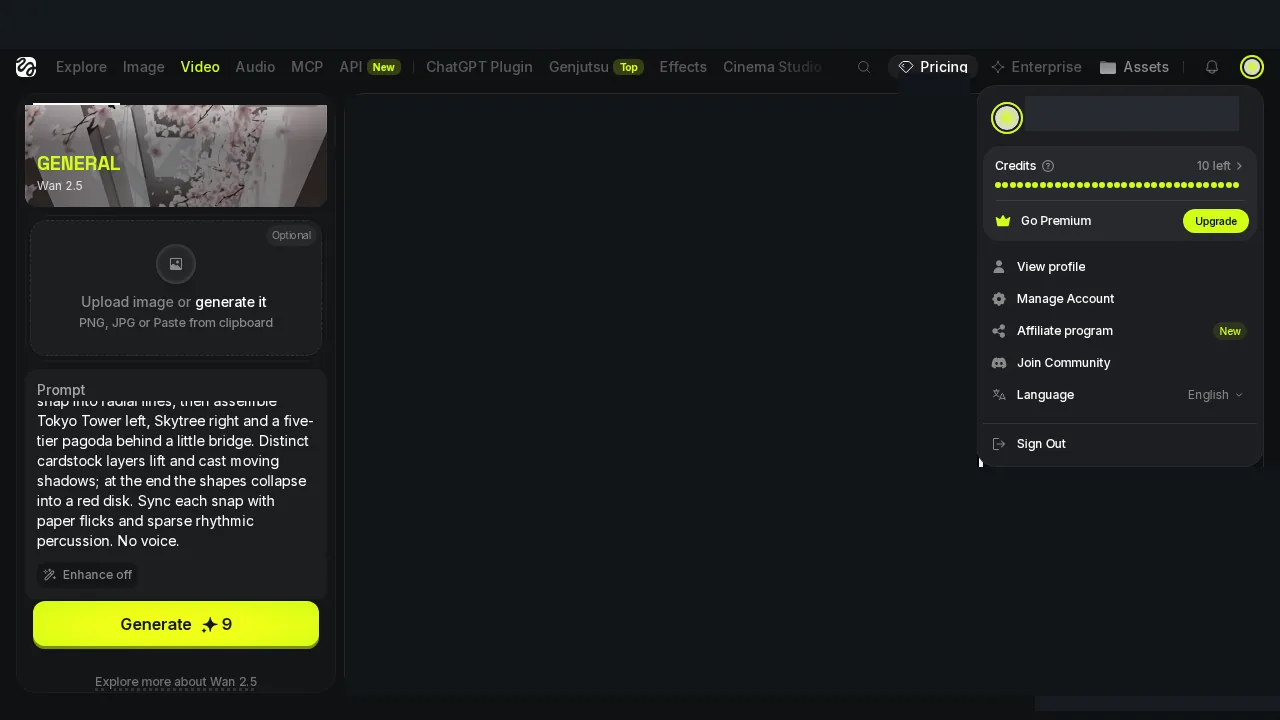
The video account displayed ten credits before this Tokyo submission; the account name is redacted.
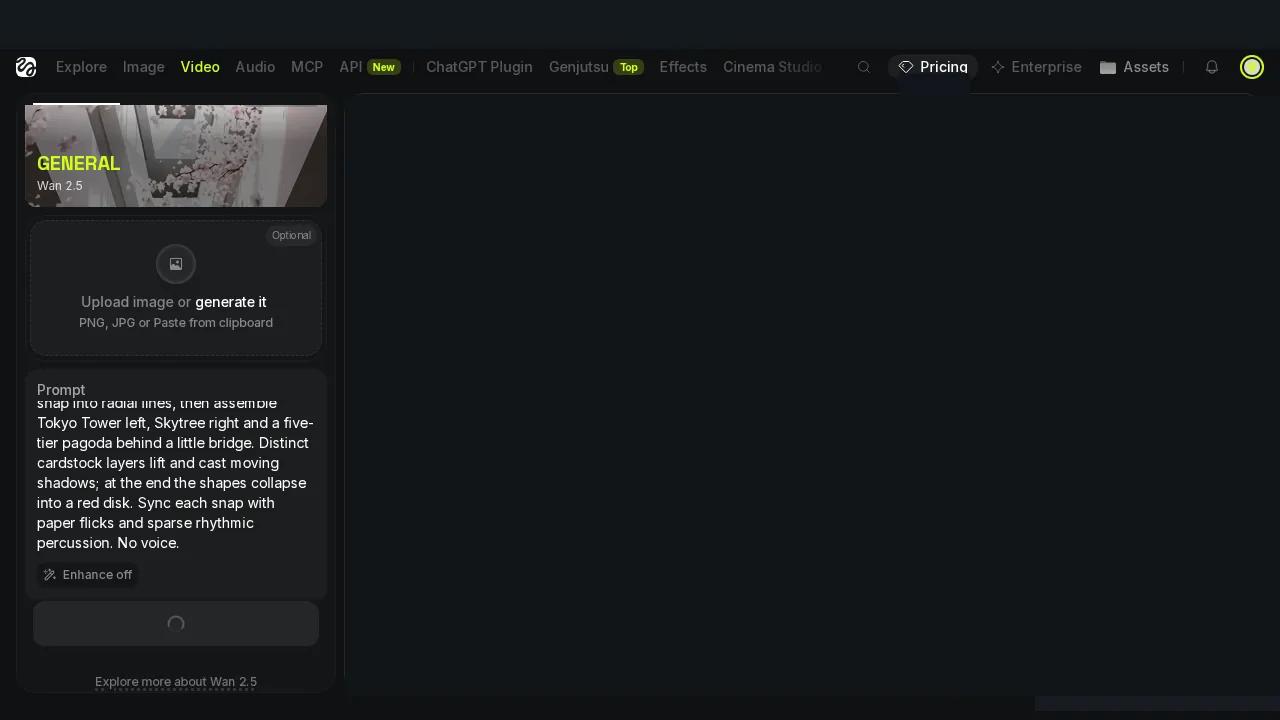
The Tokyo submission must be matched to its own completed result rather than a neighboring task card.
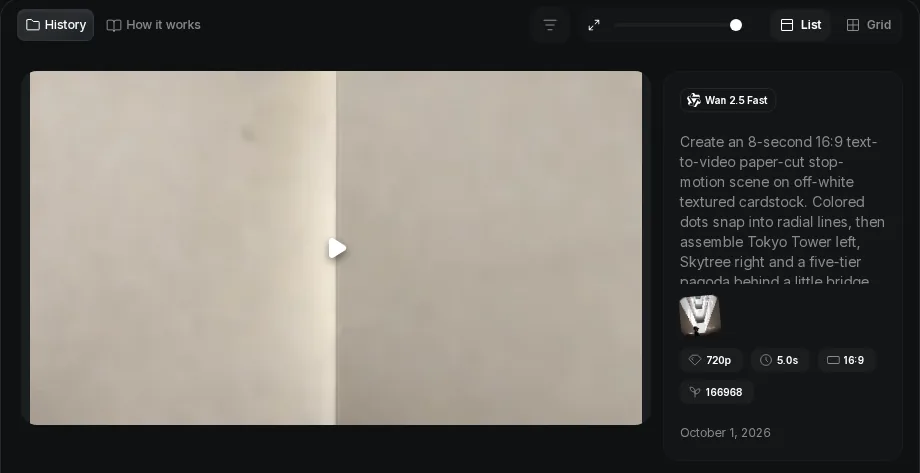
The matching Tokyo task is completed, with an output that can be opened and downloaded.
A 5-second selection is not an 8-second comparison
The Higgsfield MP4 is 5.042 seconds, despite the identical submitted prompt saying “8-second.” The UI duration selection provides the more relevant explanation for what was ordered: five seconds. The Kyncept files each measure 8.000 seconds. A claim that the test used the “same eight-second settings” would therefore be false. So would dividing both credits by eight or asserting a head-to-head winner on equal-length output.
There is another mismatch inside the Higgsfield record: the UI said 720p, while the downloaded file measures 1904×1104 pixels. That file is wider and taller than the Kyncept 1280×720 files, but its pixel width-to-height ratio is about 1.725 rather than exactly 16:9. These are measured properties of the originals, not a promise about every Higgsfield render or an explanation of the renderer's behavior. File dimensions alone say nothing about whether a motion sequence is more useful.
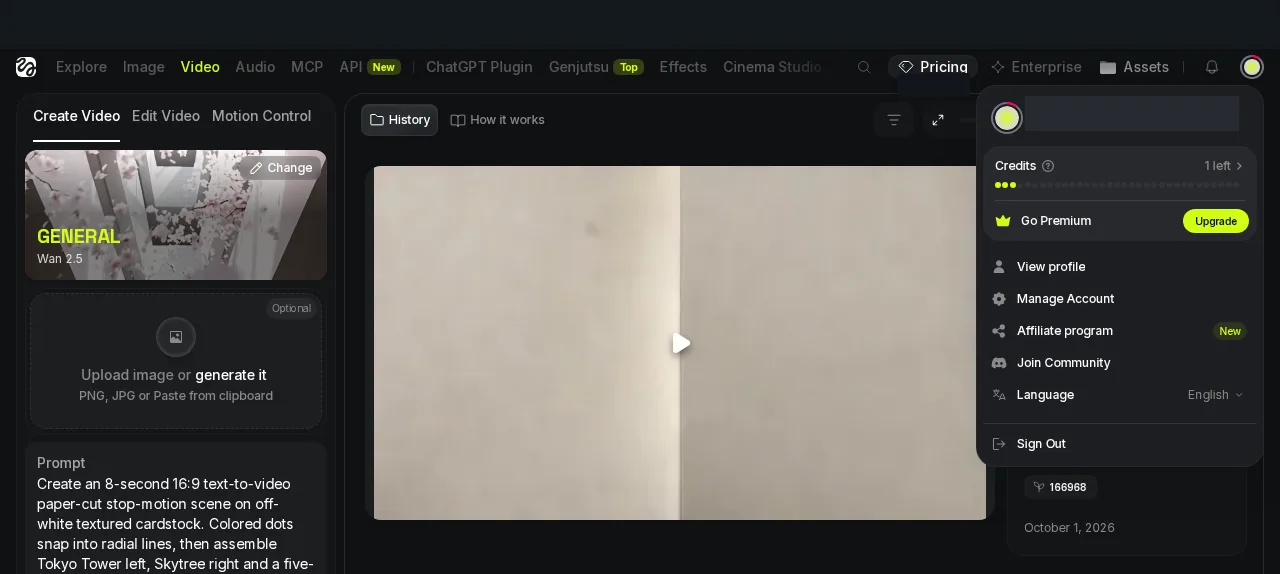
After the completed Higgsfield run the visible balance reads one, down from ten before submission.
Kyncept completed three times—and returned a similar story three times
Kyncept Plus produced three completed clips. The visible balances ran 343→333→323→313; each eight-second output therefore coincided with a ten-credit deduction in Kyncept's own accounting. All three originals decode as H.264 video with AAC stereo audio, at 1280×720, 24 fps and 8.000 seconds. Their byte lengths differ: 5,738,126; 5,733,804; and 5,737,089. Distinct file sizes do not prove distinct ideas.
This is the fairer reading of the mixed result: Kyncept fulfilled the requested duration three times and gave a recognizable ending, yet did not provide much visual variation in this three-run sample. A creator asking for alternatives should inspect them before counting them as three choices. Another prompt, model setting or day might behave differently; this test cannot answer that.
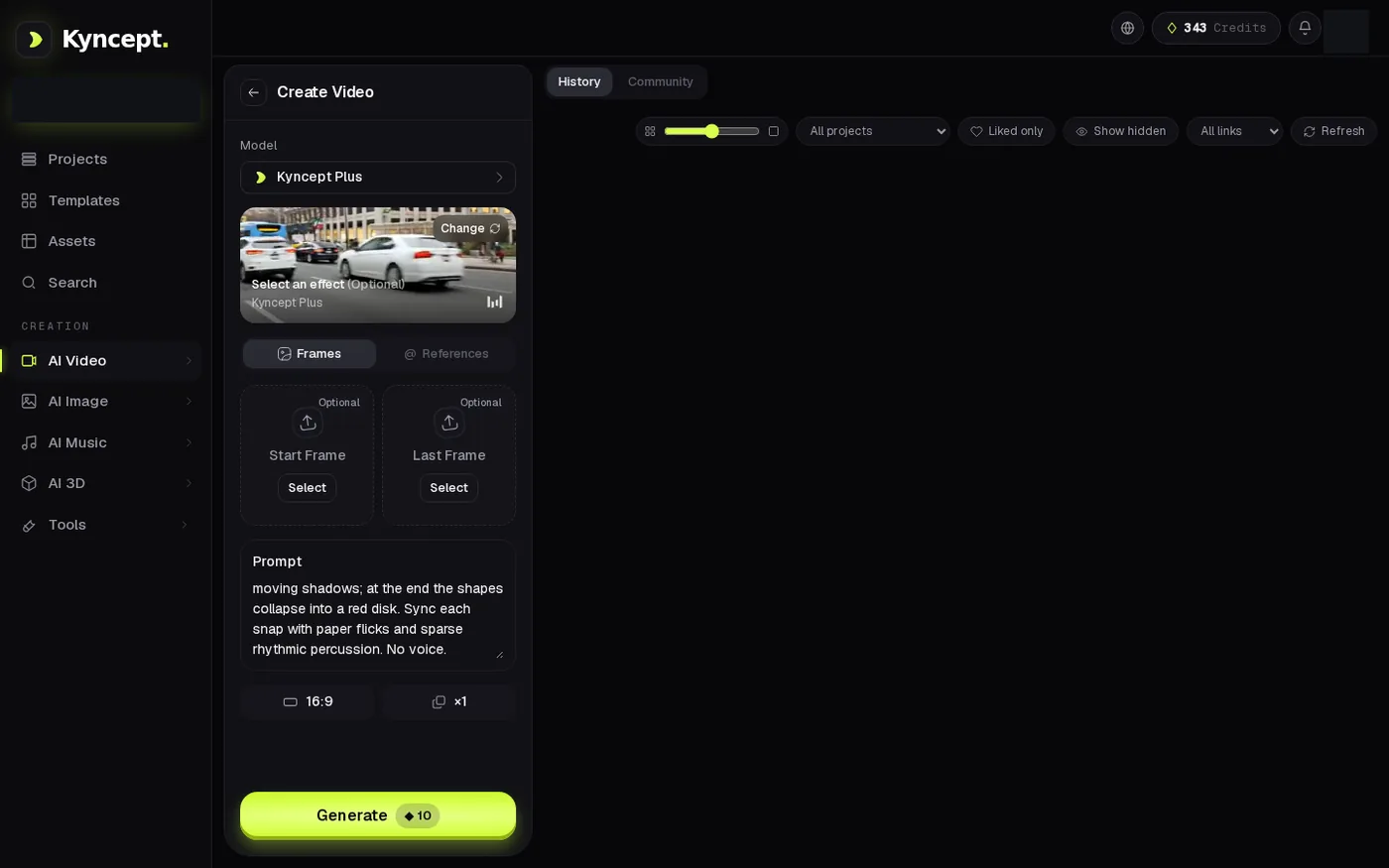
Kyncept's first Tokyo video settings and ten-credit Generate action, using the same adapted text supplied to Higgsfield.
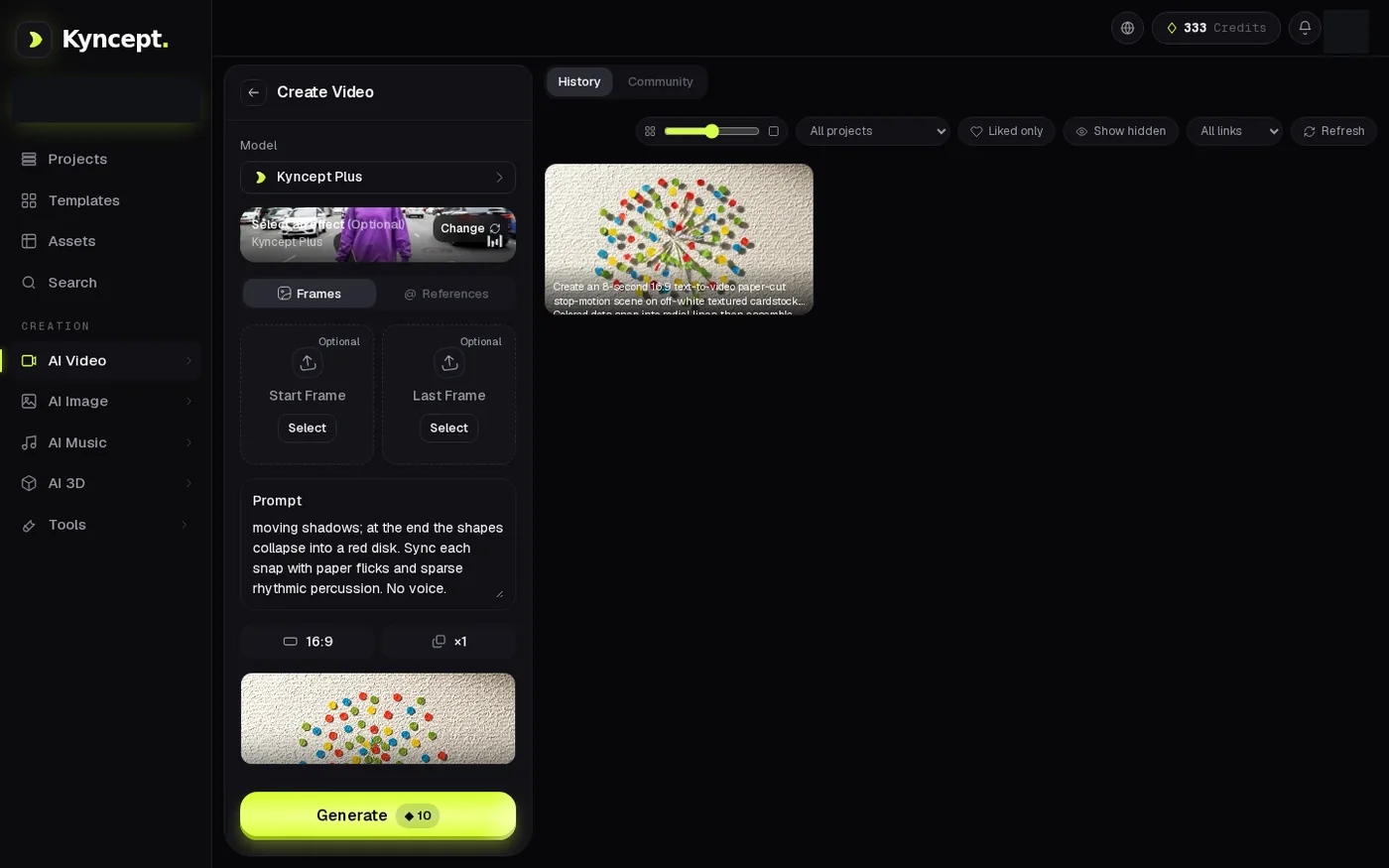
Run 1 completed and the first eight-second file was available to inspect.
The repeatability evidence is stronger than a casual glance
The three Kyncept frame grids reproduce almost the same progression: a disk of colorful dots, a red tower and blue Skytree around a pagoda and bridge, and a red circle at the end. Across whole decoded videos, pairwise SSIM was 0.988805 for runs 1/2, 0.988757 for 1/3, and 0.988794 for 2/3. On this measure, one is identical and lower values indicate larger visual differences; values this close to one agree with the side-by-side impression of very similar composition.
But this is near-repeat, not a claim of byte-identical videos. The three MP4 hashes differ, and the decoded frames differ. SSIM depends on how frames are aligned and compared; it does not tell a reader whether a subtle camera beat, changed texture or sound makes one output preferable. The three original files, not a metric alone, are the arbiter for the intended use.

Run 2: the same high-level dots → landmarks → red-disk sequence is visible.

Run 3: visually close to runs 1 and 2, but not an identical MP4 or an identical decoded frame sequence.
Three successful status cards are not three creative alternatives
Success in the UI answers whether a task completed. Variation answers a different question: whether repeatedly asking for the same idea yields genuinely different usable edits. The screenshots establish that the three Kyncept jobs finished; the grids and pairwise analysis establish that this sample did not diversify much visually. Conversely, the Higgsfield task proves one successful delivery, but one output cannot establish Higgsfield's own run-to-run diversity.
The distinction matters to an editor budgeting time. If an editor needs one specific paper Tokyo sequence, a repeat may be acceptable. If an editor needs different camera grammar for three posts, inspecting three nearly alike files can consume the intended savings. This trial has no human-scored diversity rubric, and it did not measure how many distinct alternatives either service would produce over dozens of prompts.
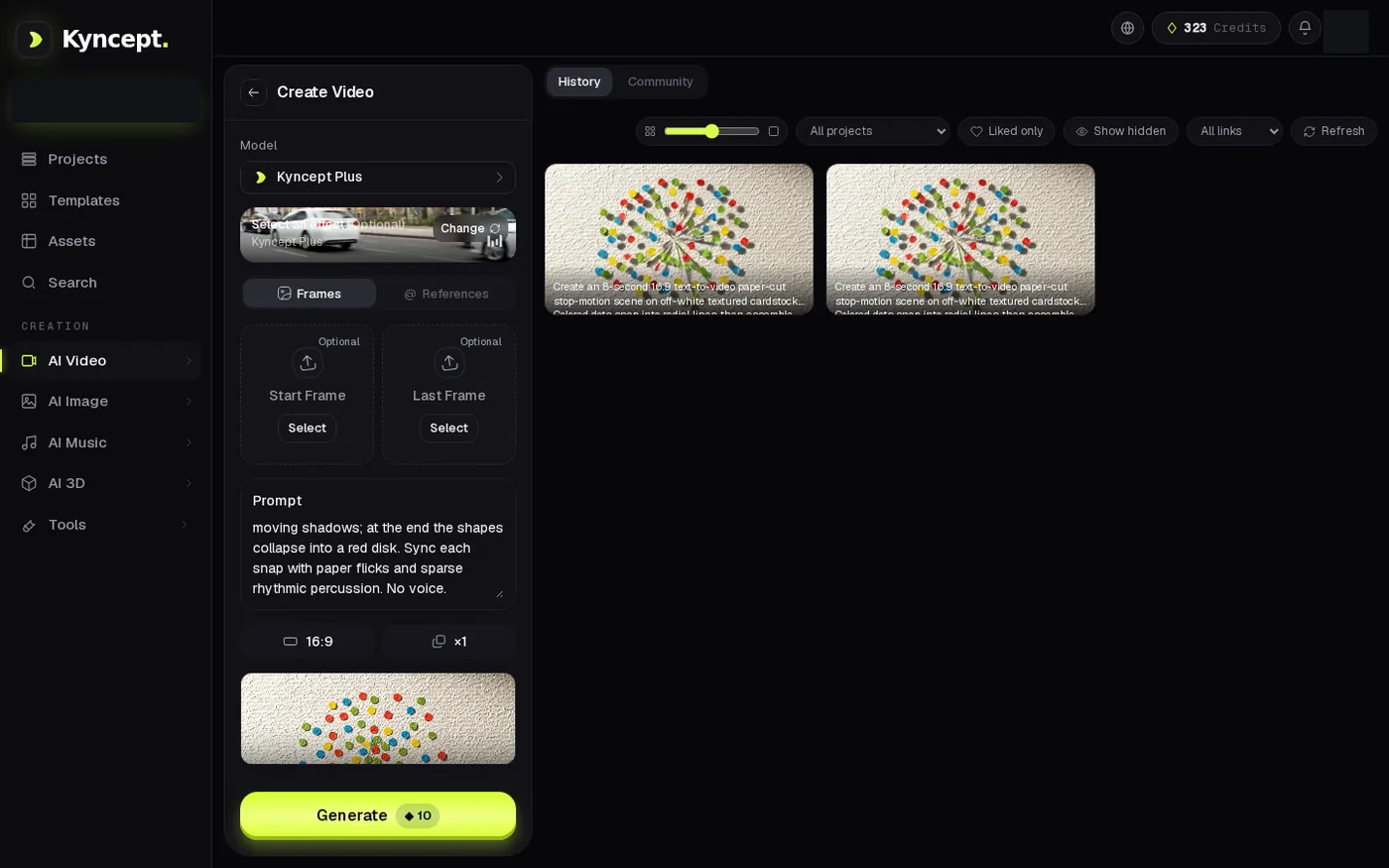
The second Kyncept Tokyo job completed; a separate status card is not itself proof of a different storyboard.
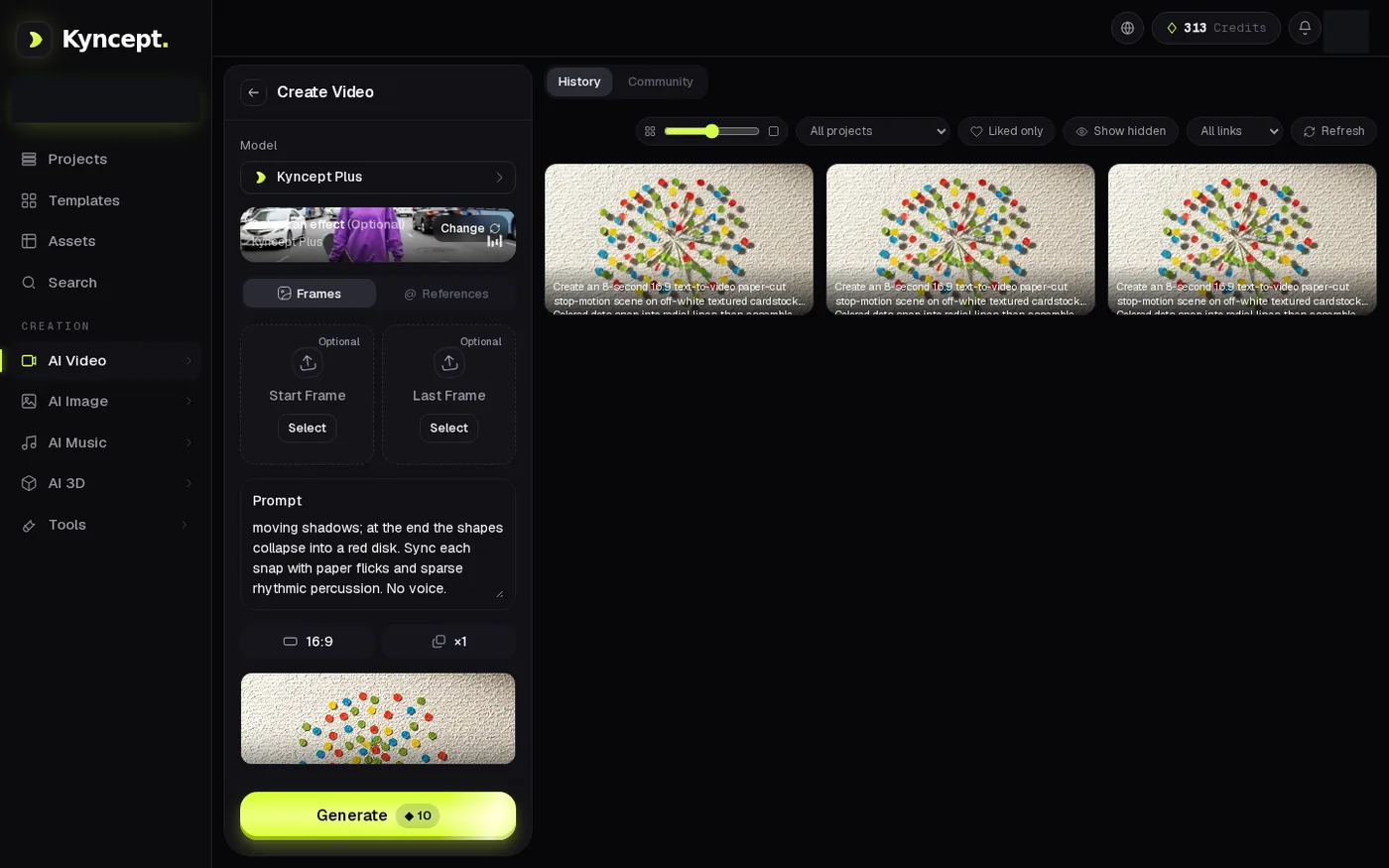
The third completed result also deserves a direct visual comparison with its two predecessors.
Audio streams do not certify the requested sound design
The four MP4s contain AAC stereo streams. That confirms encoded audio exists; it does not confirm a paper flick is audible at each snap, that sparse percussion is synchronized, or that there is no voice. We did not listen to these tracks or transcribe them. The decoded PCM audio of Kyncept runs 2 and 3 has the same hash, a narrow reproducible fact that does not establish what a listener would hear or whether it matches the prompt. Any article calling one soundtrack “perfect” from stream metadata would be inventing an observation.
The timing evidence is uneven
The Kyncept UI first showed completed at 93.698, 97.767 and 123.893 seconds after the respective Generate clicks. Those values are three observed UI intervals, not a typical speed estimate for all users. Higgsfield's precise Tokyo UI completion interval was not captured: a temporary access restriction disrupted the status check, and a later exact-task read established completion without recovering the missing second. We cannot responsibly say the Higgsfield video was faster or slower from these records.
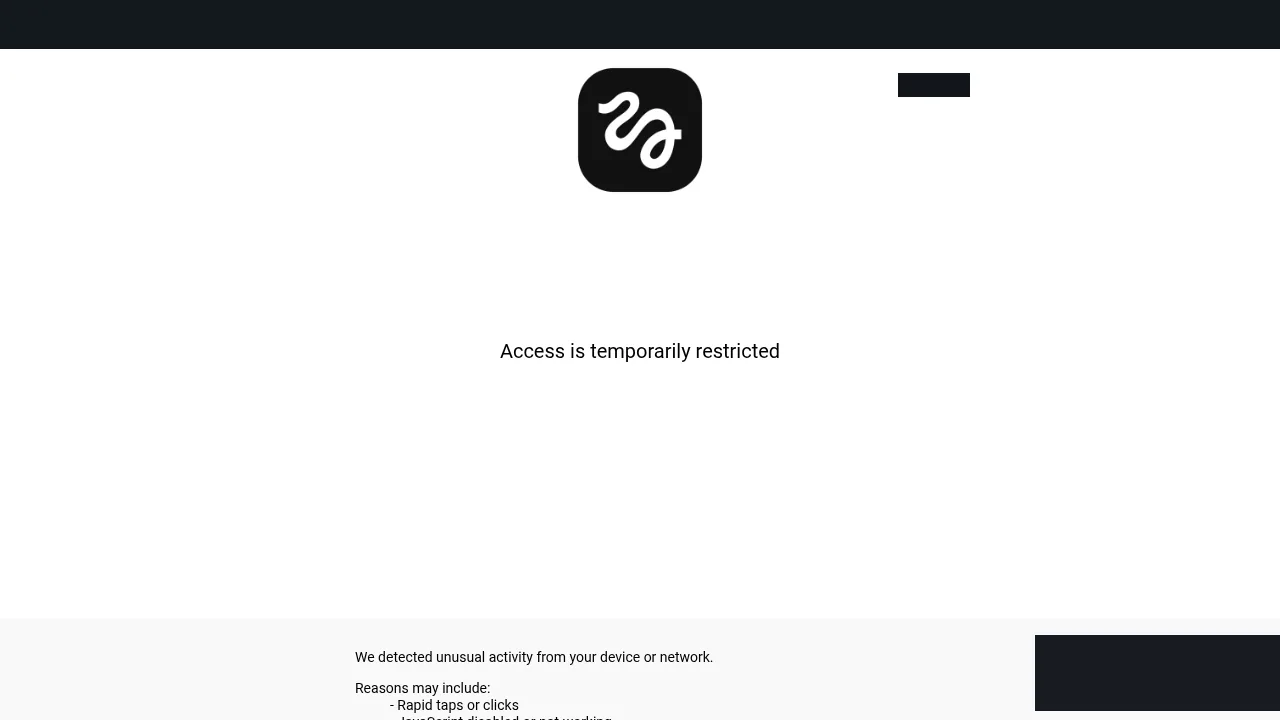
The restriction interrupted observing the task status in real time; it does not change the later verified completed outcome.
Credits are a receipt, not a currency exchange
Nine Higgsfield credits were deducted for the five-second run; ten Kyncept credits were deducted for each eight-second run. A reader can verify both within the respective interface. Nothing in those two integers says which service costs fewer dollars, because the credits belong to different subscription systems. The separate pricing article develops a clearly labeled monthly-bundle allocation using a current public price snapshot; it does not retroactively create a cash receipt for these trial jobs.
The longer Kyncept clips, the larger Higgsfield pixel dimensions and the Kyncept near-repeats all belong in any practical cost decision. A nominal “one clip versus one clip” spreadsheet that deletes those attributes is arithmetically neat but editorially misleading.
Final verdict: a real Higgsfield success and a real Kyncept caveat
Higgsfield's matching Tokyo task completed and its MP4 exists. Kyncept also delivered three completed takes, though full-frame similarity and the frame samplers show little variation among these three. Each product fulfilled a narrower part of the test. Higgsfield delivered one shorter, larger-pixel file from its five-second selection; Kyncept delivered the requested eight-second length three times with little visible diversity. Those facts are more useful than a made-up numerical score.
Which one I would use for this job
For one paper-cut Tokyo clip, I would first inspect both downloadable originals and decide whether the shorter Higgsfield treatment or the eight-second Kyncept ending fits the edit. For several different variants, I would not buy three Kyncept generations assuming they will diverge as they did not here. The Kyncept product page is a starting point for checking current options, not a substitute for verifying a specific output. No recommendation here rests on unknown sound quality or an unobserved duration control.
Originally published on Medium: Higgsfield AI Video Review 2026: One Clip, Three Near-Repeats.